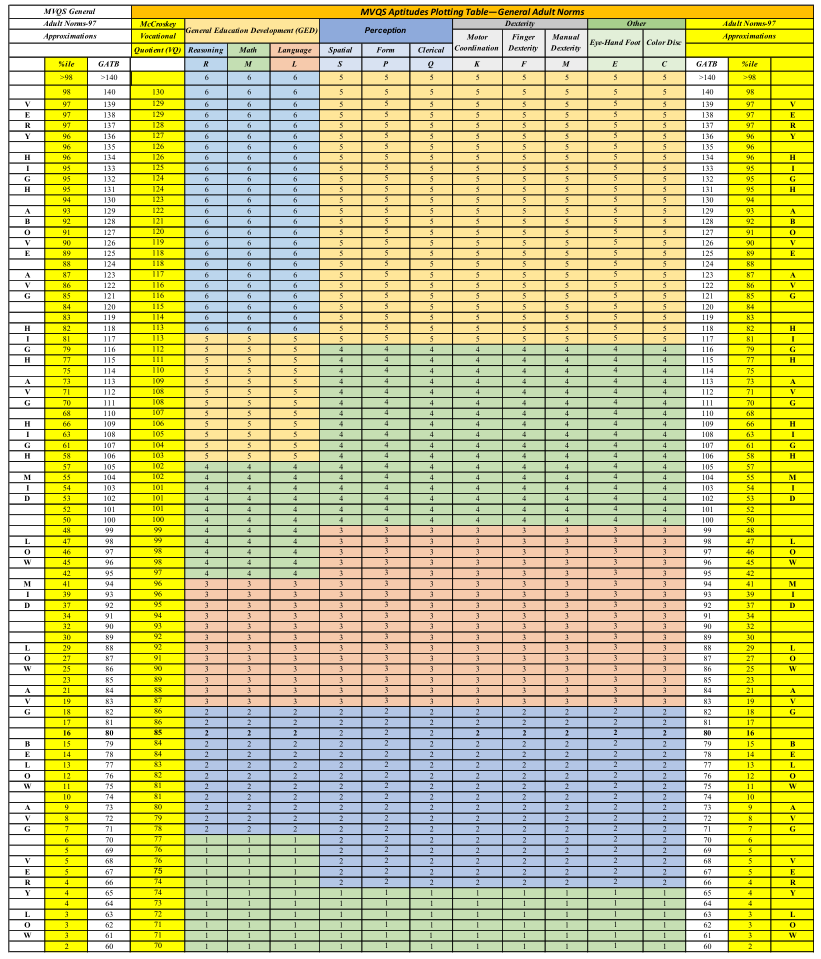
McCroskey MVQS Transferable Skills Software Program, Journal of Forensic Vocational Analysis, Vol. 24 Winter

Journal of Forensic Vocational Analysis, Vol. 24 Winter
Printed in the U.S.A. All rights reserved. ©2024 American Board of Vocational Experts
Ronald T. Smolarski
M.A., IPEC, CRC, LPC, CRV/D, CCM, ABVE/D, ABMPP/D, Certified Life Care Planner, Forensic Economist CEA, Certified Functional Capacity Evaluator, Vocational Expert
This essay provides an in-depth understanding of the most comprehensive method of evaluating an injured worker or someone whose work capacity is in question, as well as how to use the professional tools you need to provide quality workmanship in your reports. Bill McCroskey, Ph.D., and his colleague Ken Dennis, Ph.D., worked together and independently to develop the MVQS and Volcano (a subset of the MVQS). Ken Dennis has updated the VDARE+ program, which was the main platform for all transferrable skills analysis (TSA) programs used in the vocational evaluation industry in North America. Their effort allowed them to weed out all the occupations that do not exist in North America. You can review and use the updates listed on the website for VDARE+: www.pearlstreatment.com.
Is there a methodology to objectively evaluate a worker’s ability to work at a competitive and sustained rate? Can this methodology pass a Daubert challenge? Was the vocational evaluation developed by a vocational evaluator? Has the evaluation system been in existence for years? The answer to all of these questions is “yes.”
Below I present a work in progress that will show this to be the case and help you provide the most thorough and professional reports on injured workers.
This issue is important because the U.S. government at present is again attempting to develop an updated Dictionary of Titles (DOT). Past attempts have failed. Currently, economists and human resources people drawn from private contractors are attempting to throw out decades of professional vocational research in favor of subjective rather than objective data, which is unfair to society and to the average worker. They have spent a great deal of time to recognize that, for example, a one-armed worker has different rates of competencies for overhead work and waist-level work. However, we as rehabilitation counselors who also address life care planning know that one-armed tasks cause overuse syndrome (rotator cuff/carpal tunnel injuries) and therefore would cause the good arm to also become disabled.
My conclusion is that the information and procedures I am providing here, based on vocational data, are vastly superior to this current attempt at updating the DOT. Economists and human resource people are not trained to evaluate work at its very detailed and basic level. The methodology that I illustrate herein provides the rehabilitation counselor/vocational evaluator with an objective method for doing these evaluations.
We as rehabilitation counselors/vocational evaluators can objectively test such abilities as reasoning, math, language, spatial perception, clerical perception, motor coordination, finger dexterity, and manual dexterity, as well as characteristics such as interest, personality, work values, work temperament, situational assessment, and judgement and safety. We also can consult with treating physicians or physician experts as well as expert therapists to conduct a proper TSA, in terms of physical abilities, environmental tolerances, and other tolerances, including hazards, extreme temperatures, and dust and fumes.
The McCroskey Transferable Skills Program can incorporate all the values above using our vocational evaluation test results and consultations or communication with physicians, therapists, and our own clinical judgement. The objective testing and consultations with other rehab professionals and the use of MVQS provide the rehabilitation counselor/vocational evaluator with peer-reviewed values that have a standard error of estimate, dependable reliability, and clear standards. This methodology will provide a safe harbor in case of Daubert challenges.
In “California: Questioning the Vocational Expert; Criteria for Vocational Reports” (2024), Hon. Robert G. Rassp and Hon. Clint Feddersen describe the McCroskey Transferable Skills Program software as:
a proprietary computer program that takes into account the applicant’s past relevant work, skills, education, and work experience, and determines with statistical significance any transferable skills and predicted future earnings based upon jobs that an injured worker could perform. The program utilizes the U.S. Department of Labor’s Dictionary of Occupational Titles (D.O.T.) that indicates the level of skills, description of duties, and arduousness of each type of job classification in the national, regional, and local economies. This program, and perhaps others that are utilized by vocational counselors, have demonstrated validity and reliability in the courts outside the WCAB, and time will tell whether these experts and their instruments will be admitted into evidence in workers’ compensation cases.
Four-Stage Evaluation Methodology
First Stage: Work History Analysis
The first level of analysis in the MVQS incorporates the worker’s work history using values taken from the Dictionary of Titles (DOT). There are 24 values that are present in a demonstrated work history. The vocational evaluator obtains the history of relevant occupations a worker has had during the past 15 years. In the DOT, each worker trait is assigned a value according to the importance in a particular worker’s occupation. However, the rehabilitation counselor/vocational evaluator’s job analysis must include any adjustments that need to be made in the case of the individual occupation.
Second Stage: Test Score Composite
The second stage of developing a composite of test scores when using the MVQS requires the vocational evaluator to place the scores from all the evaluee’s test results into the MVQS TSA software. The next step is to place the physicians’ and therapists’ responses to the questions on the evaluee’s physical abilities, environmental tolerances, and other tolerances.
Third Stage: Clinical Judgement
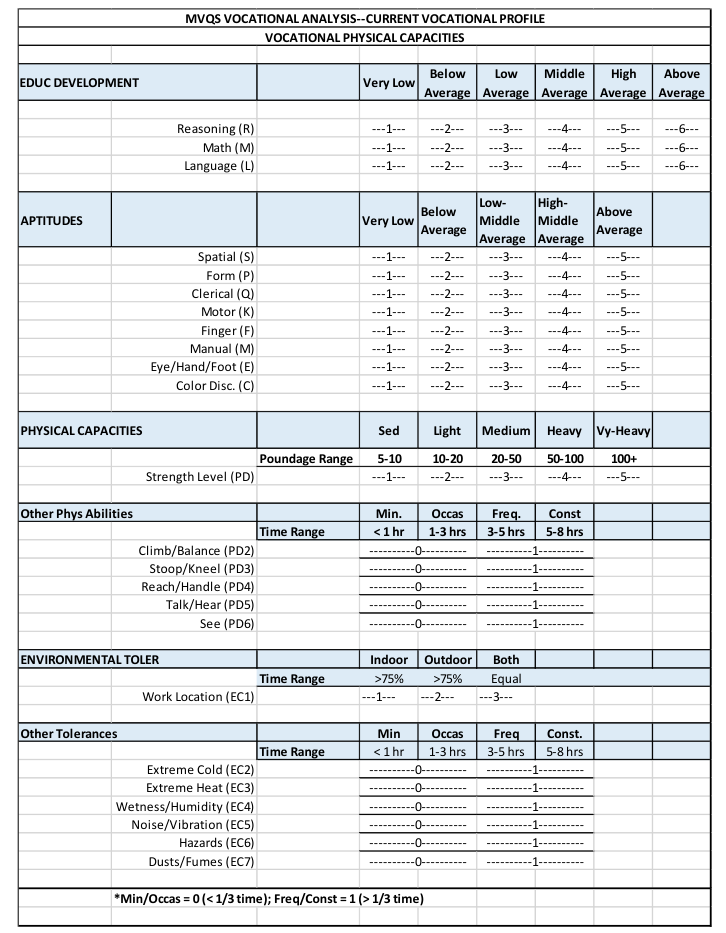
The third stage (there are 4 rows of values in the software) of evaluation is where the vocational evaluator uses his or her clinical judgement on all worker traits. One of the most important values that will need adjustment is eye/hand/foot coordination. If the evaluee had no concerns with this trait preinjury, then the trait must be adjusted to a 4 (this is an average value). The same is true for all the traits involving physical abilities, environmental tolerances, and other tolerances. If there are no previous medical conditions prior to the most recent injury, all physical/environmental traits must be moved to a 1 and work location trait to a 3 (if it is not there already). If through your collaboration with treating/expert professionals, you learn that the worker had a medical condition that would impact a worker trait in these areas, you need to decrease the trait levels.
The following traits are what most likely need to be adjusted within the parenthesized values in light of clinical judgement:
- Strength (1–3)
- Climb/Balance (0–1)
- Stoop/Kneel (0–1)
- Reach/Handle (0–1)
- Talk/Hear (1–0)
- See (0–1)
- Work Location (1–3)
- Extreme Cold (0–1)
- Extreme Heat/Humidity (0–1)
- Hazards (0–1)
- Dust/Fumes (0–1)
It is possible that the worker may have had higher test scores than the history indicated. For example, possibly a co-worker who helped with some of the worker’s responsibilities had traits that are associated with the work history. Again, if this were an issue, the vocational evaluator would need to make clinical judgement and adjust the worker traits.
Fourth Stage: Synthesis and Quantification
The fourth stage of evaluation is the last level after obtaining a work history of all DOT numbers establishing what the worker’s demonstrated work history was. At this level, the information revealed in the previous stages is the conclusion, or synthesized and quantified level of vocational worker trait factor analysis.
Key MVQS Reports
Thirty-two reports based on my analysis can be generated by the software. The most common reports that provide what is needed to determine wage loss or wage capacity (e.g., 10%, 25%, 50%, 75%, 90%) are listed below. If the worker after an injury can possibly be retrained into another occupation, it is possible to determine if the evaluee is 70% or more likely to be able to be retrained.
The most important reports, in order of use, are the following:
McDOT-Report #4 (the 24 most vocationally significant worker traits) — provides the worker’s trait levels for all worker traits in the worker’s demonstrated work history, including VQ (vocation quotient, overall sophistication/difficulty of the worker’s occupational history as indicated by worker traits in the DOT), SVP (specific vocational preparation, how long it takes to learn the occupation), skill level (unskilled, semiskilled, and skilled), and strength level (sedentary, light, medium, heavy, and very heavy).
MTSP-Report #3 (client worker trail profiles) — provides all four levels of assessment (1st level, history of DOT; 2nd level evaluation; 3rd level clinical judgement; 4th level, summary of levels 1–3).
MTSP-Report #4 (pre/post comparisons and residual employability) — provides the number of occupations in a state, province, or county. The number of occupations that have diminished from pre-injury to post-injury are accounted for, to provide a total of the number of occupations and access to employment. Access provides the percentage of occupations that exist pre- and post-injury. A section of report #4 provides training potential pre- and post-injury, as well as wage loss and earning capacity pre- and post-injury (mean, 10%, 25%, 50%, 75%, 90%), maximum vocational quotient preinjury and post-injury, and training potential. This report is run twice: once by state and once by county, or in Canada, just once by province.
Section 5, part 3 of MTSP-Report #4 provides transferable skills at the following pre- and post-injury levels:
- TS — no transferable skills available (0–19%)
- Few if any transferable skills available (20–39%)
- Low transferable skills available (40–59%)
- Moderate transferable skills available (60–79%)
- High transferable skills available (80–97%)
When using this, the vocational evaluator should only consider occupations from the low transferable skills level to the high transferable skills level. This is the only number of occupations that utilize transferable skills. If a person has no transferable skills available or few if any transferable skills available, that means the worker could perform the occupations, but the worker trait levels will only minimally assist the worker, if at all.
MTSP-Report #10 (job matches by transferrable skills — present value earning capacity) — provides the occupations that the worker now has available after injury. This report provides the DOT#, occupation titles, transferable skills level, VQ (vocational quotient), SVP (specific vocational preparation), VA (worker values), VIPR (interest/personality test), and wage level (mean level, 10%, 25%, 50%, 75%, and 90% wage level).
When using the wage level for post-injury, use 10% if the worker has no experience in the industry and 25% if the worker has some experience in the industry. If your state or province has a minimum wage rate, use that rate rather than the 10% wage rate level. If the worker’s employer paid the injured worker more than the wage rate levels, use the rate that the employer paid the worker for past wages. If your state or province uses wage capacity rather than wage loss, also incorporate the average worker profile (DOT 999.999-999) for your work history after you conduct your worker trait factor analysis. Take the average means of all previous demonstrated occupational history dollar amounts along with the average worker profile, then divide the total dollar amount for all the DOT dollar amounts, and multiply by 2080 work hours in a year to obtain the annual dollar wage capacity for the injured worker — for cases of personal injury, medical malpractice, wrongful death, workers comp, product liability, or for wrongful discharge cases or matrimony damage cases.
MTSP-Report #7 (Work History by VQ — Present Value Earning Capacity) — the last report in this sequence. If seeking to obtain work capacity, enter the average worker profile (DOT 999.999-999) as a separate input to the demonstrated work history and add the average worker profile after you have inputted all test scores and clinical judgment and collaboration data to the MVQS and completed your final synthesis and quantifying in your vocational evaluation (which gives you wage loss). If your state or province allows wage capacity instead of wage loss, you can re-run the program for MTSP-Report #7 after inputting the average worker profile. This second report provides: DOT code, occupational title, vocational quotient, specific vocational preparation, values agreement (worker’s values), Vocational Interest and Personality Reinforcer (VIPR), and wage levels (mean – 90%).
Synthesizing Objective Testing Results
The McCroskey MVQS allows the rehabilitation counselor/vocational evaluator to synthesize all their objective testing results: educational development (reasoning, math, language), and aptitudes (spatial perception, form perception, clerical perception, motor coordination, finger dexterity, manual dexterity). Results of your collaboration with physicians and other experts regarding the worker’s condition will also be incorporated, including functional capacity evaluation (FCE) for physical capacities, eye/hand/foot coordination, color discrimination/vision and all the environmental concerns (strength, climbing, stooping/kneeling, reaching/handling, talking/hearing, seeing), work location (indoors or outdoors), extreme heat, wetness/humidity, noise/vibration, hazards (moving mechanical parts, electrical shock, working on high places, exposure to burns and radiation energy, explosives, and/or toxic chemical and biological agents), and work values (achievement/working conditions; recognition/relationship; support/independence).
For example, the rehabilitation counselor/vocational evaluator will include results of data interpreted by physicians and other experts, such as X-rays, MRIs, the Minnesota Multiphasic Personality Inventory (MMPI), etc.
There are a couple hundred types of educational development and aptitude tests loaded into the McCroskey MVQS. Make sure that any new test you want to add to the MVQS has a reliability of 70% or greater.
Work values and interest test scores are also part of the synthesis. Using clinical judgement, the rehabilitation counselor/vocational evaluator can also conduct a more refined analysis using temperaments, situational assessment values, leisure interest surveys, the functional capacity checklist, the Oswestry Disability Questionnaire, the McGill Pain Questionnaire, the Katz Index of Independence in Activities of Daily Living, Judgement and Safety Screening Inventory, the Lawton-Brody Instrumental Activities of Daily Living Scale, the Jamar Dynamometer Grip Strength/Pinch Strength, and life care plan data.
Charts are included in the appendices to help better understand the worker traits and their values and incorporate them into your reports and vocational analyses. A sample physician letter and neuropsychologist letter are also provided to assist in obtaining responses from the physician and therapist, rather than receiving limited or no cooperation or guarded words. The key tip used in these letters to obtain clear responses is to include the evaluee’s answers to questions regarding their capacities and the clinician’s responses to and conclusions regarding those answers (using FCE results and Epic Spinal Function Sort/Hand Function Sort findings), then request that the physician (in most cases a physiatrist, because they are the only physicians taught physical function in medical school and can address long-term care) to agree or disagree and make an adjustment to the conclusions.
If the only physicians available to answer your questions are orthopedists, neurologists, general practitioners, or any other doctors besides physiatrists, it will be difficult to impossible for them to answer the questions about physical function and return to work. In this case, it is recommended that you ask the attorney to obtain a physiatrist. It is worthwhile to cultivate a relationship of your own with a physiatrist who can serve in these instances. Many practitioners may not have training as a functional capacity evaluator, but forms are available from the Employment Potential Improvement Corporation (available in English and Spanish) from Matheson & Associates, which also provides training in functional capacity evaluations.
Standard Error of Estimate vs. Relative Standard of Error
The MVQS program uses a Standard Error of Estimate to predict income. The data provided by the government is a Relative Standard of Error (that is, consistency of data collection; this is what the private federal contractors are using for their attempt to update the DOT). That does not predict income. It predicts the error of measuring information that is provided to the government. Predicting income is not the same as predicting the accuracy of counties, metropolitan service areas, and states reported information.
References
Rassp, G. & Feddersen, C. (June 19, 2024). California workers’ compensation discovery [excerpt]. LexisNexis. https://www.lexisnexis.com/community/insights/legal/workers-compensation/b/recent-cases-news-trends-developments/posts/california-questioning-the-vocational-expert-criteria-for-vocational-reports
Appendix A
Quick Reference for Predictive Validity (Rxy) & Known Error Rates (SEE) In the 4 VQ Bands used for Curvilinear Earning Capacity Prediction
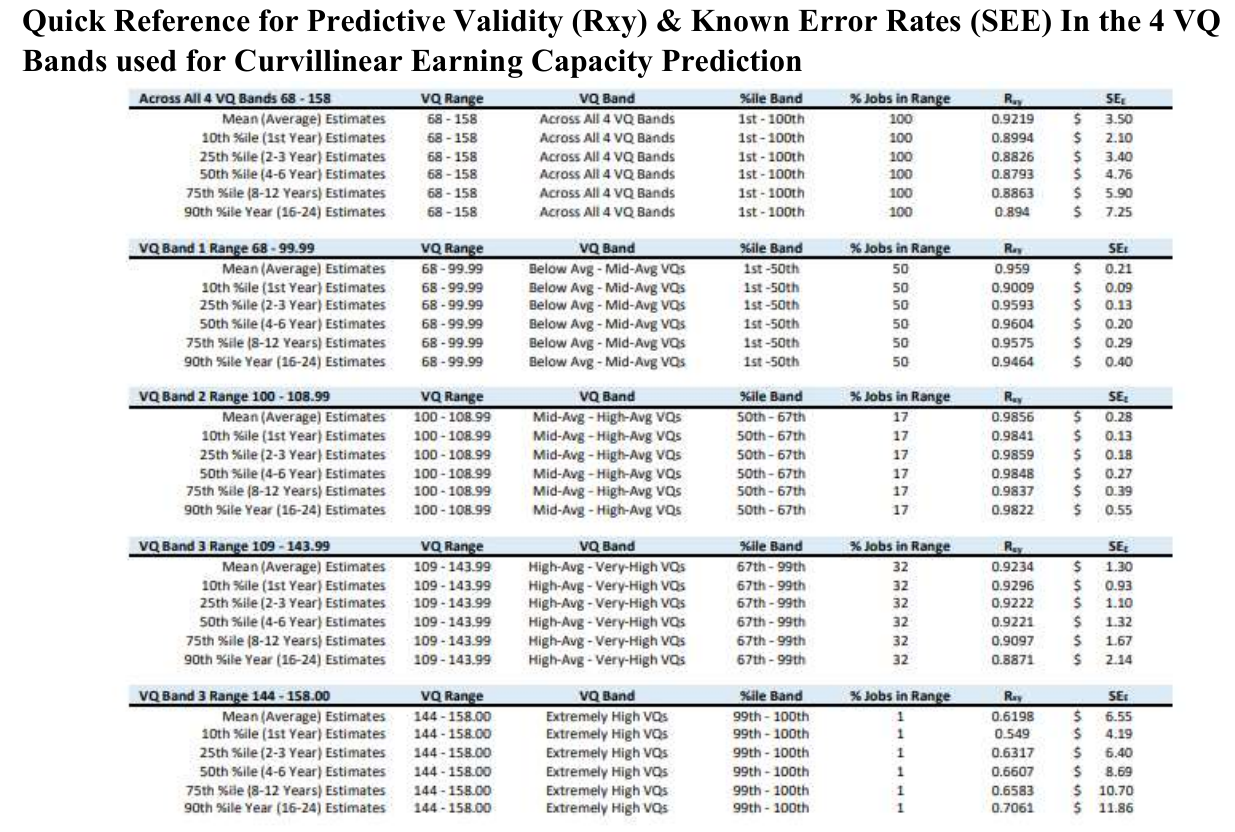
Interpreting VQs, Rxy, Validity & Standard Error (SEE) for Earning Capacity for a Job VQ within a VQ Band
The Vocational Quotient for each Job in the MVQS McDOT Program is a unique indicator of overall Job Difficulty, relative to all other Jobs in the McDOT Program. The Mean VQ across all jobs in McDOT is 100, with a Standard Deviation of 15 VQ points. The average VQ Range is from 85 to 115, where 67% of all Job VQs fall. The overall VQ distribution ranges from a low of around 68.00 to a high of around 158.00. To determine the relevant Rxy, Predictive Validity Coefficient and SEE Known Earning Capacity Error for a given Job VQ:
- Search for the job in McDOT Report Outputs and identify the VQ for the selected job.
- Locate the VQ Band (above) within which the identified VQ for the selected Job falls.
- Decide which of the six possible estimates you wish to use within the VQ Band selected.
- Locate the Rxy (Predictive Validity) Coefficient and the SEE (Known Error Rate) at the end of the selected row.
Note 1: Rxy Predictive Validity Coefficients > 0.7000 fall in the very high to extremely high prediction estimates range.
Note 3: If two jobs in a given Labor Market have the same VQ, the Earning Capacity Predictions would be the same, as would be the SEE.
Appendix B
MVQS Vocational Analysis — Current Vocational Profile
Appendix C